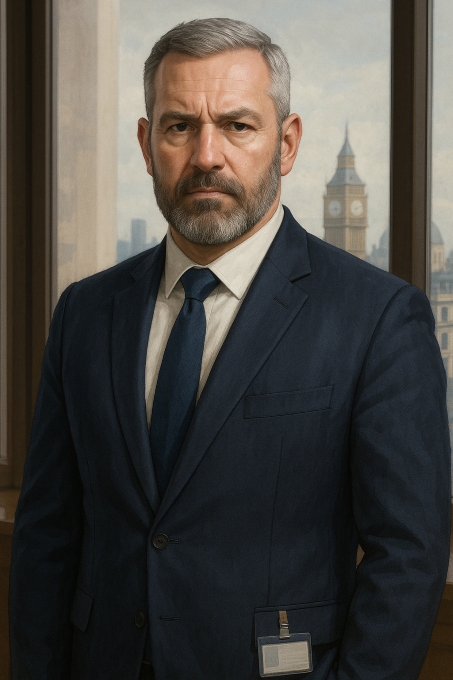
Major General Sir Alastair “Al” Muir (Retired)
Name Sir Alastair “Al” Muir (Retired)
Position UEO Chief Liaison
Rank Major General
Character Information
| Gender | Male | |
| Species | Human | |
| Age | 56 |
Physical Appearance
| Height | 6' 1" | |
| Weight | 203 lbs | |
| Hair Color | Grey | |
| Eye Color | Blue-Grey | |
| Physical Description | Alastair Muir is a broad-shouldered, powerfully built man in his late fifties to early sixties, carrying his age like someone who has stayed fit through discipline rather than vanity. Standing 6'1" (185 cm) and weighing around 203 lbs, he has the solid, imposing presence of a former field commander who hasn’t let himself soften. His grey hair is cut short and neat, matched by a moderately full, well-kept grey beard that gives him an air of authority without looking severe. |
Family
| Spouse | Dr Fiona Kerr (museum conservator) |
|
| Children | Eilidh Muir (Daughter, 31): Forensic archaeologist with the Crown Office & Procurator Fiscal Service (heritage crime/cold-case recoveries). Occasionally advises HWC on provenance and repatriation ethics. Calum Muir (Son, 28): RAF engineering officer (avionics) posted to RAF Waddington; periodically seconded to UK Space Command trials. Healthy process–pragmatism debates with his dad. Isla Muir (Daughter, 25): NHS emergency medicine registrar in London. Brings a sharp clinical eye to family arguments about off-world medical ethics. Ruairidh Muir (Son, 22): Final-year physics student at the University of Glasgow (signals & materials). Eager, a bit idealistic; has opinions about “open science” that make Alastair sigh. |
|
| Father | Angus Muir (1943–2015) — Northern Constabulary/Police Scotland Inspector; long-time Cairngorm Mountain Rescue volunteer leader. |
|
| Mother | Mairi Muir (née MacLeod) (1946–2021) — Secondary school headteacher |
|
| Brother(s) | Iain Muir (Deceased): Former Royal Navy Warrant Officer (navigation), later Harbour Master at Ullapool. Killed during a Goa’uld attack (classified incident). His loss is the quiet engine behind Alastair’s refusal to grandstand or gamble with lives; anniversaries pull him back to the hills. Fraser Muir: GP in Inverness; volunteer medic with Cairngorm Mountain Rescue. Community-first and sometimes sharp with government secrecy; he and Alastair argue, then align. |
|
| Sister(s) | Catriona Laurent (née Muir) — Sister: Senior civil servant, UK Cabinet Office (London); frequent secondments to Brussels/Geneva. Married to Anaïs Laurent (French EU diplomat). The family’s other strategist; Alastair’s read on Whitehall/EU moods. Morven Álvarez (née Muir) — Sister: Marine biologist in Plymouth with South Atlantic field seasons. Married to Dr Diego Álvarez (Spanish oceanographer). Calm, wry; keeps Alastair honest on environmental costs. Ailsa Njoroge (née Muir) — Sister: Former investigative journalist, now comms director for a humanitarian NGO in Nairobi. Married to Kamau Njoroge (human-rights lawyer). People-first; Alastair’s early-warning for public sentiment. |
|
| Other Family | Beyond the immediate Muir clan, Alastair has a small circle of people he treats as family, whether or not they share his name. On Fiona’s side, her parents Douglas and Margaret Kerr—retired teachers in Stirling—quietly adopted him years ago. Douglas is the only person who will tell Alastair to sit down, eat something and stop talking about acronyms, and get away with it. Fiona’s younger brother, Alasdair Kerr, is a quietly successful architect in Edinburgh; he and Alastair share a dry, slightly absurd sense of humour that surfaces at the worst possible moments, usually at Christmas. From his service days, there are a handful of “brothers and sisters in arms” who have standing invitation status at any Muir gathering. Chief among them is Warrant Officer (now Mr) Jamie “Jock” Fraser, his former company sergeant major, who retired to Moray and runs a small outdoor kit shop. Jock is the one person who will still call him “sir” purely to wind him up, then switch to “Alastair” when the conversation turns serious. Another is Colonel Rachel Singh, once a fellow young officer in the Scots Guards and later a colleague in Afghanistan and at Permanent Joint Headquarters; the two of them are godparents to each other’s children and have an unspoken pact to tell one another when they are working too hard or drifting off course. There are also the families he feels responsible for, even if they might not think of themselves that way. Hannah MacAskill Muir, Iain’s widow, and their children sit in that category; he checks in more than he admits and quietly steers support their way when he can. A couple of former subordinates who came home with visible and invisible scars have, over time, become something closer to younger siblings—people he will always make time for, even if it means taking a call in the middle of a long night in the control room. Taken together—Kerrs, Frasers, Singhs, in-laws, godchildren, and the scattered handful of men and women who once stood beside him in bad dust and worse weather—they form the wider web that anchors him. They are the people he imagines reading the headlines, or the letters, when he makes the hard calls, and the reason he is so careful about how often he lets the mission come first. |
Personality & Traits
| General Overview | On the surface, Alastair Muir is exactly what people expect from a former Major General running a secret programme: calm, tidy, and hard to rattle. He listens more than he talks, lets other people burn off noise, then boils everything down to a couple of clear options and a decision. He is formidable but fair; you always know where you stand with him, even if you do not like the answer. He does not shout, does not grandstand, and has very little time for theatrics dressed up as leadership. Underneath that, he is a family man from a big Highland clan who never quite forgot the kitchen-table rules he grew up with: look after your own, tell the truth, and make sure everyone gets a seat. His instinct is to protect his people and his partners, to count the exits and build the safety nets—but he is honest about the rare days when the mission really does have to come first, and he carries those calls heavily. A dry streak of humour stops him becoming too grim; he will puncture tension with one well-placed line and then go straight back to the work. He is not trying to be a legend. What he wants, most days, is to get the job done cleanly, keep as many people alive as possible, go home to Fiona without a casualty letter in his bag, and know that if one of his kids—or one of his officers—asked him whether it was worth it, he could look them in the eye and say yes. |
|
| Strengths & Weaknesses | Alastair’s strengths sit where upbringing, army life, and Whitehall experience overlap. He is exceptionally calm under pressure, able to strip chaos down to a handful of clear courses of action and make a decision without drama. Years in the Scots Guards and later at Permanent Joint Headquarters and the Cabinet Office have made him a natural coalition broker: he can translate between generals, scientists, diplomats and politicians and get them to sign the same page. His leadership is quietly protective—he counts exits, rehearses medical evacuation, insists on rules of engagement people can repeat half-asleep, and owns the consequences upwards when risk has to be taken. He has a strong moral spine shaped by his parents, Fiona’s ethics around culture, and Iain’s death; that gives him credibility when he says either “the mission bends around the people” or, on the rare day, “today the mission must come first.” Off-duty, his ties to family, mountain rescue and veteran mentoring keep him grounded and make him more than a uniform or a title. Those same qualities leave seams and weak spots. His instinct to carry the burden himself can turn into isolation; he’ll absorb blame and shield others to the point of neglecting his own wellbeing and, occasionally, shutting people out. The weight of past losses—especially Iain’s death and the letters he has written to other families—feeds a quiet guilt that can make him overly cautious until the situation is unquestionably dire, then brutally decisive. His reliance on structure and process, while usually a strength, can make him impatient with improvisation that comes from a good place, especially from younger, more idealistic officers. He has a tendency to underplay his own emotional needs, using dry humour and work as armour, which risks fraying relationships if he forgets that his family and closest colleagues need more than the polished briefing-room version of him. And while he understands that the mission sometimes has to come before the man, he knows that line is thin; the fear of crossing it for the wrong reasons is something his enemies could exploit and his conscience never quite lets him forget. |
|
| Hobbies & Interests | Alastair’s main refuge is the hills. He prefers long, steady days in the Cairngorms or the Lake District, map in hand, a flask in his pack and at least one unlucky family member persuaded into proper boots. He supports Cairngorm Mountain Rescue through fundraising and training events when he can, more out of loyalty to his parents and Iain than any desire for attention. At home he is a quiet bookworm. His shelves run to military history, crime novels and the occasional piece of science fiction pressed on him by one of the kids. He has a guilty fondness for terrible police dramas, which he watches largely so he can mutter about bad procedure. He cooks decent, unfussy food—stews, roast dinners, things that feed a table rather than impress Instagram—and has a well-hidden appreciation for good single malt whisky, taken sparingly and without fuss. He is also a habitual map hoarder: OS maps, old charts, annotated printouts of places he has walked or worked. Planning a route, even one he will never take, is a way of thinking. Less visibly, he puts time into mentoring a small circle of veterans and younger civil servants, preferring quiet coffees to formal schemes. Family time—Sunday dinners, group chats full of photos and sarcasm—isn’t a hobby as such, but it is the thing he protects in the diary when he can, and the lens through which he judges whether the job is still worth doing. |
| Personal History | Alastair Muir grew up in Inverness, the middle of a noisy, close family. His dad, Angus, was a Police Scotland inspector who spent winters on Cairngorm Mountain Rescue. His mum, Mairi, taught Gaelic and History and ran a tight but kind household. There were six kids: Catriona, Iain, Morven, Alastair, Fraser, and Ailsa. Army life Alastair commissioned into the Scots Guards in 1990. Sandhurst gave him polish; a first platoon gave him purpose. His early years straddled the tail end of Operation Banner (Op Banner) and a short, wary peace, followed by a snap to the Balkans where the rules changed with the radio traffic. He learned fast that leadership wasn’t the voice on parade but the quiet word in a doorway at 03:00—and that you count your exits before you step through any gate. Promotion brought him through company posts and Brigade staff, then Permanent Joint Headquarters (PJHQ), where he discovered he could turn military, scientific, and diplomatic noise into one plan people would actually follow. The Intermediate Command & Staff Course (Land) sharpened his pencil: fewer acronyms, more second-order effects, and a healthy suspicion of clever ideas that cost lives. Company command fixed his broad priorities—people first, then mission, then narrative—but Afghanistan taught him that sometimes the order bends. He ran short, clean rehearsals, insisted on red-team questions, and wrote orders you could read after no sleep. In Afghanistan he led joint crisis cells for repatriation, casualty tracking, and cross-agency liaison: unglamorous work that saved lives and taught him to prefer small, well-briefed teams with exits that weren’t “we’ll see.” Battalion command widened the map to multiple agencies, allied clocks, and a media cycle that didn’t care about your timings. Secondments into Government Communications Headquarters (GCHQ) and Defence Intelligence put him near the first whispers of “exotic” signals at the edge of operations. He wasn’t the smartest technician in the room; he was the one who got the technicians and the operators to sign the same page. He lost people he still carries; he wrote more letters to families than he ever talks about. When younger officers asked what leadership was, he said: be there first, leave last, tell the truth quickly. There were moments when “people first” had to flex. An improvised explosive device (IED) threat against a civilian convoy forced a hard choice: stand a tired platoon down, or hold the line and bring families through a potential kill zone. He kept the platoon in place and escorted the convoy—mission before man, by minutes and by necessity. The lesson wasn’t bravado; it was structure. State the risk, publish the rules of engagement (ROE), rehearse medical evacuation (MEDEVAC), name the exits, and carry the decision yourself. What he carried forward into civilian life was simple: checklists over bravado; small teams, clear exits; coalition literacy (able to speak American procurement, French doctrine, and non-governmental organisation (NGO) scepticism without losing his own voice); care for families (a private list of anniversaries he never forgets); and humour as armour, the dry line that saves more arguments than rank. He never chased medals, but they came—General Service Medal (GSM) with clasps, operational service (Northern Ireland, Balkans, Afghanistan), and NATO service. The only one on his office wall is a framed company photo with too many signatures around the border. Command & hard lessons Company command put Alastair squarely in the space where plans meet people. In Afghanistan, he learned quickly that good intent is worthless without clean orders, rehearsals, and a third exit that isn’t “we’ll see.” He insisted on rules of engagement (ROE) everyone could repeat at 03:00, and drilled medical evacuation (MEDEVAC) until it was muscle memory. When an improvised explosive device (IED) shattered a patrol’s timing, he cut the clever plan, simplified the route, and brought everyone home. The lesson that stuck was simple: checklists over bravado. He was pulled into interagency crisis work—repatriation, casualty tracking, cross-border liaison—where he discovered he could make uniforms, diplomats, and scientists sign the same page. He ran short, ruthless after-action reviews (AARs): what did we try, what actually happened, what changes on Monday. He always made space for the quiet voice at the back of the room, because that was often where the uncomfortable truth lived. Secondments put him alongside Government Communications Headquarters (GCHQ) and Defence Intelligence, skirting the edges of “exotic” signals that did not fit the usual maps. He was rarely the smartest technician in the room; he was the translator—turning probabilities into choices, risks into courses of action (COAs) with named owners and clocks attached. He pushed for small, well-briefed teams and killed off dramatic options if they burned people for the sake of narrative. He learned coalition literacy the hard way: speak American procurement without promising the moon, read French doctrine without losing tempo, and treat non-governmental organisation (NGO) scepticism as a useful red flag rather than an obstacle. He wrote letters to families he never talks about, kept a private list of anniversaries, and made a habit of telling the truth quickly—up the chain and to his own people. Across his AARs, a pattern emerged. Nine times out of ten, the team came first and the mission was shaped around them. The tenth time was different—when the wider mission clearly outweighed local risk. On those days he said it out loud, wrote it down, and made sure the burden sat on his desk, not his sergeant’s: today, the mission comes first. The safeguards stayed the same—clear intent, counted exits, rehearsed MEDEVAC—but everyone knew exactly why they were being asked to carry the extra weight. General rank & beyond Promoted to general rank in 2016, Alastair found himself in the rooms where commas move budgets and timings move lives. He was seconded often to the Cabinet Office Briefing Rooms (COBR) to help steer whole-of-government responses. His value wasn’t volume; it was turning noise into two or three clear courses of action (COAs) with named owners and clocks attached. He became a quiet bridge between the Ministry of Defence (MoD), the Foreign, Commonwealth & Development Office (FCDO), the Home Office, and Permanent Joint Headquarters (PJHQ). He kept meetings short, minutes honest, and outcomes measurable. If a plan read well but bled people, he binned it. When partners disagreed, he traded what mattered: lift, logistics, legal cover, and real search and rescue (SAR) guarantees. At COBR tables he argued the same line he had used in the field: the default is to protect your people, but there are rare days where the mission genuinely protects many more. On those days the order flips—mission before man—and he insists that the calculus is spoken aloud, written down, and paired with a recovery plan, not just a tasking. No quiet, implied sacrifices; if the risk is higher, everyone hears it from him. Those years also pushed him up against the edge cases—odd signals, stranger incidents—working alongside Government Communications Headquarters (GCHQ) and Defence Intelligence. He was not the scientist in the room; he was the adult who asked, “What do we stop, start, or safeguard by Friday?” He wrote that habit into process: speak plainly, count exits, and respect cultural lines even when frightened. In 2021 he retired from the Army as a Major General, invested Knight Commander of the Order of the Bath (KCB) for steady, unshowy leadership. Instead of walking away, he walked across the street, taking a civilian post in the Cabinet Office (Resilience). There he wrote the first practical playbooks for “space/unknown-contact” scenarios and began the quiet diplomacy that would become the United Earth Organisation (UEO) Alliance compact—UK test slots and logistics in exchange for enforceable protections: asylum reviews in writing, medical intellectual property sharing, and guaranteed SAR. Those civilian highlights—crisp COBR process, coalition literacy, and ethics with teeth—are why, in 2024, he was asked to stand up Homeworld Command as a civilian Director-General, dual-hatted as the London liaison to the UEO Alliance. The job has not changed his rules. He still speaks plainly, still counts exits, and still puts people before narrative—until the rare day when the mission genuinely must come first, and then he says so, out loud, with the plan to bring as many of them home as the universe allows. Family Alastair comes from a big Highland family where you learned to speak up, but also to listen. His parents, Angus Muir and Mairi Muir (née MacLeod), set the tone. Angus was a Northern Constabulary/Police Scotland inspector and long-time Cairngorm Mountain Rescue volunteer, the kind of man who would disappear into a blizzard because someone’s teenager had not come home. Mairi was a Gaelic and History teacher who became a headteacher; she believed in manners, stories, and never leaving anyone out at the table. Both are gone now—Angus in 2015, Mairi in 2021—but their voices are still in his head every time he weighs risk: count your exits, and treat guests with dignity. He is the middle of six. His eldest sister, Catriona Laurent (née Muir), works in the UK Cabinet Office on resilience and public policy, with regular stints in Brussels and Geneva. She is the only person who can out-bureaucrat him and gets away with saying so. His older brother, Iain Muir, served as a Royal Navy warrant officer in navigation before becoming Harbour Master at Ullapool; he was killed in a Goa’uld attack, a classified incident that still sits under everything Alastair does. Iain’s widow, Hannah MacAskill Muir, and their small branch of the family remain a quiet priority. His younger sister Morven Álvarez (née Muir) is a marine biologist based in Plymouth, often away on South Atlantic research cruises. She is calm and wry and reminds him that every “infrastructure solution” has an environmental cost. Fraser Muir, his younger brother, is a GP in Inverness, married to Dr Siobhán O’Rourke, an A&E doctor; their children, Euan and Mhairi, are the excuse for half the silly photos on his phone. The youngest, Ailsa Njoroge (née Muir), is a former investigative journalist turned communications director for a humanitarian non-governmental organisation (NGO) in Nairobi, married to human-rights lawyer Kamau Njoroge. She is his external conscience on public sentiment and the first to text him when secrecy starts to look like arrogance. Alastair married Dr Fiona Kerr, a museum conservator who lives and breathes provenance and repatriation. She has no interest in his rank but very strong views on what counts as theft, which has shaped his hard lines on cultural property and how Homeworld Command handles off-world artefacts. They have four children: Eilidh, a forensic archaeologist working with the Crown Office on heritage crime and cold cases; Calum, an RAF engineering officer (avionics) at RAF Waddington, occasionally seconded to UK Space Command trials; Isla, an NHS emergency medicine registrar in London; and Ruairidh, a final-year physics student at the University of Glasgow. Family messages range from shared hill photos to unvarnished opinions on his work. The Muirs are spread across the UK and beyond, but they still operate like a single, argumentative unit. Birthdays and anniversaries matter; so does Iain’s date of death. Alastair keeps a private list of those days. For all the clearances and titles, he measures his choices by a very small circle: what would Angus and Mairi think, how will this read to Fiona, and what will he say if one of the kids, or Ailsa, asks him straight out whether the mission really had to come first. That is the standard he lives with. Off-duty Away from briefing rooms and sub-basements, Alastair is almost worryingly normal. He stays “hill-walker fit” rather than gym-obsessed, favouring long days in the Cairngorms or the Lake District with a map, a flask and whoever in the family he can persuade into decent boots. He still turns out for Cairngorm Mountain Rescue fundraisers and training events when he can, more as “Angus and Mairi’s lad” than as Sir anyone. The hills are where he goes to think, and where Iain’s absence is felt the most. Home, when he manages to be there, is a London flat full of books, OS maps, and mugs that never quite match. Fiona keeps the art sensible; he sneaks in the odd battered regimental print. Sunday dinner—whether in London, Inverness or on a video call spanning three time zones—is sacrosanct. It is where family gossip, sharp questions about ethics, and gentle mockery of his latest press photo all happen in one sitting. He mentors a quiet handful of veterans and civil servants, preferring one-to-one coffees to formal schemes. His advice is practical rather than inspirational: write things down, sleep if you can, do not lie to yourself just because the briefing note sounds better that way. He is known in a few corridors as the person you can visit when you have made a hard call and need help living with it. Off-duty hobbies are modest. He reads history, crime novels and the occasional bit of science fiction his kids push at him. He has a soft spot for bad police dramas, mostly so he can complain about procedure. He drinks whisky sparingly but properly, and makes decent, unfussy food when left to his own devices. On the rare nights when the flat is quiet and the inbox is under control, he will sit by the window with a dram, phone face down, and let himself feel the weight of the days when the mission came first—and the relief of the many more when it did not. |
|
| Service Record | Northern Ireland (end of Op Banner), Balkans. Early reputation for calm under sustained pressure. 1999–2004 — Company & Staff, Brigade of Guards / PJHQ Coalition planning exchanges; first exposure to NATO and EU operational politics. 2004–2010 — Battalion Command & Joint Assignments Afghanistan tour; led interagency crisis cell on repatriation and liaison. 2010–2016 — Director-level MoD Posts (Crisis & Capability) JSOC-adjacent UK tasking; embedded with GCHQ/DSA on emergent “exotic” signals issues. 2016–2021 — General Officer, Operations & Resilience Brought into Cabinet Office during major national crises; chaired working groups bridging MoD/FCDO/Home Office. 2021 — Retired from the Army (Major General) Invested KCB for services to international security and measured command. 2021–2024 — Cabinet Office (COBR/Resilience) Director Built cross-government playbooks for “space & unknown contact” contingencies. 2024–Present — Director-General, UK Homeworld Command (civilian) Dual-hatted as UEO Alliance Liaison (London Desk). |